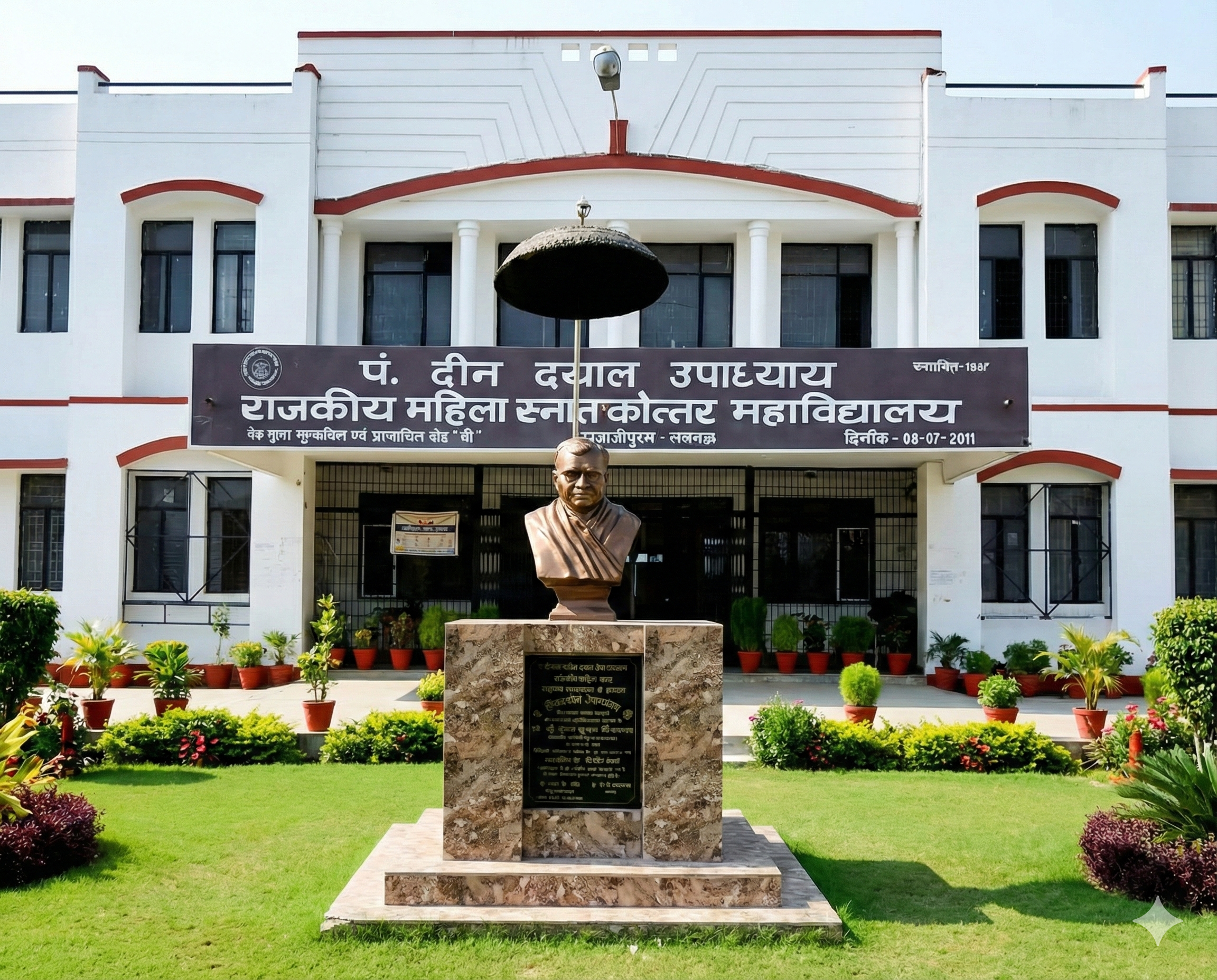
Pt. Deen Dayal Upadhyay Rajkiya Mahila Snatkottar Mahavidyalaya, Rajajipuram, Lucknow, Uttar Pradesh, is a premier government institution dedicated to women’s higher education. Established in 1997 in the capital city of Uttar Pradesh, the college was founded with the objective of expanding access to quality higher education for women, particularly from urban and semi-urban backgrounds. The institution came into existence through the visionary support of the then Hon’ble Prime Minister of India, who contributed ₹25 lakh under the Members of Parliament Local Area Development Scheme (MPLADS) and laid the foundation stone on 13 April 1997. The campus infrastructure, developed by the Uttar Pradesh Housing and Development Board, Lucknow, comprises well-planned and independent academic blocks for the Faculties of Arts, Commerce, and Science.
The academic journey of the institution began with the Faculty of Arts (Undergraduate) in the academic session 1997–98, followed by the Faculty of Commerce in 2003–04, and the Faculty of Science in 2006–07. By 2008–09, the college had achieved a student strength of 1,977, reflecting its expanding academic outreach and growing reputation. Since July 2007, the college has also served as a Study Centre of Uttar Pradesh Rajarshi Tandon Open University, Prayagraj, offering a wide range of diploma, postgraduate diploma, undergraduate, and postgraduate programmes including Financial Management, Health Education and Nutrition, Library Science, Diet and Nutrition, Fashion Designing, Sociology, Hindi, Economics, and Home Science.
The college offers postgraduate programmes in English, Sociology, History, Economics, Home Science, and Chemistry, along with undergraduate programmes across disciplines. In compliance with the directives of the Government of Uttar Pradesh, computer literacy is a compulsory component at the undergraduate level, ensuring students acquire essential digital competencies. The institution houses a well-stocked central library with more than 12,000 books, journals, and reference materials, providing strong academic support for teaching, learning, and research.
The campus is enriched with robust academic infrastructure, including four science laboratories, two Home Science laboratories, and dedicated Psychology and Anthropology laboratories, facilitating experiential and practical learning. The college has also established five fully functional Smart Classrooms, promoting technology-enabled pedagogy. Recognizing the importance of physical well-being and sports, the institution maintains a 125 × 89 metre playground, along with facilities such as a badminton court, open gym, indoor gymnasium, and sports laboratory. Through its Sports Board Cell, the college actively participates in college-level, university-level, and state-level competitions.
The college has successfully implemented the National Education Policy (NEP) 2020, focusing on multidisciplinary education, academic flexibility, skill development, experiential learning, and holistic student growth. It is equally committed to environmental sustainability, maintaining a green and eco-friendly campus with abundant vegetation, solar-powered street lighting, and sustainable practices.
Beyond academics, the institution emphasizes the holistic development of students through its NCC Unit, Rover Rangers, National Service Scheme (NSS), Institutional Innovation Cell (IIC), Pt. Deen Dayal Upadhyay Awadh Sanskritik Club, and Road Safety Club. Collectively, these foster discipline, leadership, cultural awareness, social responsibility, civic consciousness, innovation, and entrepreneurship. Pt. Deen Dayal Upadhyay Rajkiya Mahila Snatkottar Mahavidyalaya continues to play a vital role in empowering women through quality higher education in Uttar Pradesh.
Pt. Deen Dayal Upadhyay Govt. Girls P.G. College Sector 11, Near New Tempo Stand Rajajipuram, Lucknow, U.P., India
+0522-2417600
pracharyaddu@gmail.com
Subscribe for latest news & upcoming events